
About the Schaffermahlzeit
... quickly explained
How it all began
The Schaffermahlzeit dates back to Bremen’s history as a port and trading city. Since joining the Hanseatic League in 1358, Bremen has developed into an important economic metropolis in the north-west – with its own merchant fleet, large shipping companies and traditional shipbuilding companies.
The Schaffermahlzeit emerged from this Hanseatic merchant tradition: an annual meal that brings together merchants, captains of the STIFTUNG HAUS SEEFAHRT and invited guests – for centuries, right up to the present day.

Dr. Angela Merkel
Chancellor
The ceremony
The Schaffermahlzeit follows centuries-old rules – and that is precisely what gives it its special character. The event is held in a festive setting: men in tailcoats, captains in uniform and women in long black evening gowns gather in the Upper Town Hall for a communal meal.
The guest list is also special: external guests – often from the worlds of business, science or politics – are only allowed to attend once. An invitation is therefore considered a great honour.


The food
Originally, the Schaffermahlzeit began as a simple meal of stockfish. Today, it has become a festive multi-course menu – served in a tried-and-tested order at stylishly laid tables in the Upper Town Hall.
The meal is accompanied by clever, pointed speeches – profound, but not without humour. The Schaffermahlzeit thus combines culinary delights with Hanseatic dialogue culture.
You can find the exact schedule here.
The Schaffermahlzeit
On the second Friday in February, the Oberen Rathaushalle (Upper Town Hall) hosts the Bremer Schaffermahlzeit – the world’s oldest annual friendship banquet, which is still held today. Since 1545, the event has symbolised the solidarity between shipping and merchant communities – ‘so that it may be upheld firmly and unbreakably for all eternity,’ as the Council of the Hanseatic City of Bremen once put it.
The banquet has a clear purpose: to collect donations that go entirely to the STIFTUNG HAUS SEEFAHRT foundation. The funds are used to support seafarers in need and their families – and, for several years now, to support nautical students.
Around 100 seafaring and 100 commercial members of HAUS SEEFAHRT who are currently working or have already completed their careers take part in the Schaffermahlzeit. They are joined by around 100 invited guests from the worlds of business, culture, politics and administration – with one special feature: they are only allowed to attend once in their lifetime. An invitation is therefore considered a special honour.

Federal President Horst Köhler
about the Schaffermahlzeit
2027 – THE 483. SCHAFFERMAHLZEIT
Schaffer of the mercantile membership
1. Schaffer André Grobien
2. Schafferin Kerstin Schwimmbeck
3. Schaffer Hermann Bosse
Schaffer of the nautical membership
Captain Michael Thomas Ippich
Captain Dirk Müller-Arnecke
Captain Jan Böttjer
Captain Thomas Kühnemann
Captain Roland Münster
Captain Thomas Mrusek
2026 – THE 482. SCHAFFERMAHLZEIT
Schaffer of the mercantile membership
1. Schaffer Dirk Zeppenfeld
2. Schafferin Nadine Kloska
3. Schaffer Dirk Olaf Rogge
Schaffer of the nautical membership
Kapitän Tim Nordmann
Captain Immo Lakmann
Captain Olaf Enno J. Linnemann
Captain Horst Müller
Captain Richard Chalhoub
Captain Lisa Brenneisen
2025 – THE 481. SCHAFFERMAHLZEIT
Schaffer of the mercantile membership
1. Schaffer Thorsten Rönner
2. Schaffer Julius Runge
3. Schaffer Alexander Schnitger
Schaffer of the nautical membership
Captain Dirk Eberding
Captain Olaf Köberl
Captain Daniel-Philipp Riehl
Captain Frank Rolf Krämer
Captain Soeren Schmitz
Captain Oliver Richardt
2024 – THE 480. SCHAFFERMAHLZEIT
Schaffer of the mercantile membership
1. Schaffer Philip W. Herwig
2. Schafferin Dr. Heidi Armbruster-Domeyer
3. Schaffer Jan-Oliver Buhlmann
Schaffer of the nautical membership
Kapitän Jan-Helge Janssen
Kapitän Roman Lehnhoff
Kapitän Jürgen Hamel
Kapitän Ulf Wolter
Kapitän Kai Oltmanns
Kapitän Gerd Stamm
2023 – THE 479. SCHAFFERMAHLZEIT
Schaffer of the mercantile membership
1. Schafferin Janina Marahrens-Hashagen
2. Schaffer Jens Lütjen
3. Schaffer Dr. Christoph B. Klosterkemper
Schaffer of the nautical membership
Captain Ulrich Werner Tetzlaff
Captain Jörn Haase
Captain John Peter Marcus
Captain Dennis Brand
Captain Johannes Reifig
Captain Frank Lehmann
2022 – THE 478. SCHAFFERMAHLZEIT – CANCELLED
Schaffer of the mercantile membership
1. Schaffer Dr. Johann Christian Jacobs
2. Schaffer Johann G. Smidt
3. Schaffer Cornelius Strangemann
Procedure and schedule
What once began as a simple stockfish meal is now a festive feast with a clear structure and established rituals. Guests take their seats at festively decorated tables and enjoy a multi-course menu accompanied by speeches that are as clever as they are entertaining – profound, but never humourless.
The sequence of dishes follows a fixed order that has remained unchanged for generations. At HAUS SEEFAHRT, they like to call it a ‘simple, old Bremen meal’ – simple in origin, dignified in setting.


1st course: Bremen chicken soup
- Speech by the first Schaffer (welcome address)
- Speech by the second Schaffer on the Federal President and the Fatherland
- 3rd verse of the German national anthem
2nd course: Stockfish, mustard sauce, boiled potatoes
- Speech by the third Schaffer on Bremen and the Senate
3rd course: Seafaring beer
- Speech by the first Schaffer for trade, shipping and industry
4th course: Brown cabbage, Pinkel sausage, smoked meat, chestnuts, fried potatoes
- Speech by the second Schaffer at Haus Seefahrt, head and senior elder
- Collective speech by the managing director – collection for ‘HAUS SEEFAHRT’
5th course: Roast veal, celery salad, Catherine plums, steamed apples
- Speech by a captain to the new commercial managers
- Speech by the third Schaffer to the new captain creators
- Speech by the first Schaffer to the foreign guests
- Thank you speech by the managing director to the Schaffer
6th course: Riga herring, anchovies, sausage, tongue, Chester and cream cheese, fruit basket
- Captain's speech
- Speech by the guest of honour
- Clay pipes and tobacco
- Coffee/Mocha
You can find an explanation of the individual dishes here:
Bremen chicken soup and Riga butter
The Schaffermahlzeit begins with a Bremen chicken soup, as described by Betty Gleim in her cookbook published in 1808. The Bremen chicken soup is, so to speak, the first course before the welcome address by the 1st Schaffer, the speech by the 2nd Schaffer on the Federal President and the fatherland, and the 3rd verse of the German national anthem. The last course is Rigaer Butt, also known as Rigsche Butten or Rigaische Butten. This is smoked plaice from Riga, which is served at the Schaffermahlzeit together with anchovies, sausage, tongue, Chester cheese and cream cheese, as well as a fruit basket for dessert – before the speech by a captain’s Schaffer and the speech by the guest of honor. Rigaer Butt is a reminder of the Bremen colony in Livonia, which in turn is a historical region in what are now Estonia and Latvia. There is a little story behind this: a Bremen ship laden with goods, which was on a coastal voyage (known as cabotage at the time), had strayed off course and had to enter the Daugava River. What initially seemed like bad luck later turned out to be a stroke of fortune. On the banks of the Daugava River, the people of Bremen, led by Canon Albert von Buxhövede, who was appointed Bishop of Livonia by the Archbishop of Bremen and called himself Albert I, founded the city of Riga in 1201, as recorded in the chronicle of Rinesberch, Schene, and Hemeling (early 15th century). Unfortunately, the co-author and mayor Johann Hemeling (died 1428), who was responsible for this information, cheated a little when he wrote: “Albertus buwede (built) the city of Riga with the borgeren (citizens) of Bremen.” From today’s historical perspective, the founding of Riga by the people of Bremen is untenable, but that should not bother us. The date, 1201, is correct in any case. And Rigaer Butt has been eaten at the Schaffermahlzeit since time immemorial.
Stockfish – the main meal
It is quite possible that stockfish was the main course for the Schaffer from the very beginning. Stockfish was either served with melted butter or with a “white, thick, very tasty sauce,” as Johann Georg Kohl wrote in the mid-19th century, “which is expertly prepared in Bremen.” Today, stockfish is served with mustard sauce.
Stockfish is split and dried cod, which the people of Bremen have been importing from Norway since time immemorial. It was popular in Bremen, especially as it was relatively cheap. Today – in the age of fresh fish – stockfish is hardly ever served.
Johann Georg Kohl writes in his book “Alte und neue Zeit” (Old and New Times) that in the 18th century, stockfish was the “inevitable dish served every Friday,” but it did not have only fans at the lunch table.
Kohl: “If the table companions, especially the young comptoirists who had immigrated from abroad, did not like the taste of this Bremen dish and chewed it very slowly, the old Bremen host would make a most displeased face.”
Kale and sausage
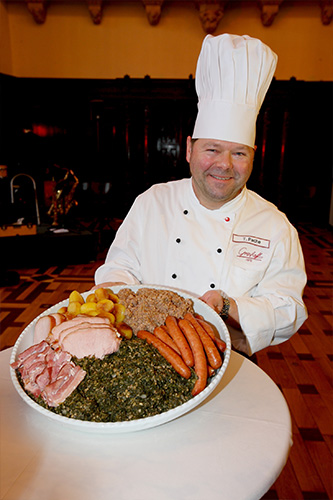
The potato, which is now an indispensable part of every lunch table in Bremen, had a very difficult start in the Hanseatic city.
When HAUS SEEFAHRT was founded, potatoes did not yet exist in Europe, and when they did, the people of Bremen did not like them for a long time. Even in the 18th century, they still considered potatoes to be harmful, unhealthy, and poisonous.
Kale, known elsewhere as green cabbage, was served with carrots, turnips, and chestnuts, which are still served today at every Schaffermahlzeit. The fact that fried potatoes are now also served with cabbage is a concession to the times and to the out-of-town guests at the Schaffermahlzeit.
After all, one cannot expect them to have to grapple with a dish that contains several unknown ingredients. It is important to know that it takes an old and strong habit to find cabbage and Pinkel enjoyable. Karl-Josef Krötz, the long-standing former Ratskellermeister, who comes from a winery on the Moselle and has felt very much at home in Bremen for years, recently said during a cabbage dinner that cabbage and Pinkel were certainly not what drew him to Bremen.
At the top of the list of unknowns that make up this favorite dish of the people of Bremen is Pinkel. We are, of course, talking about Bremen Pinkel, not Oldenburg Pinkel.
Pinkel is a type of sausage made from kidney fat, streaky fresh bacon, flomen (beef fat or tallow), plenty of onions, and roughly the same amount of oat groats. Around 20 grams of salt per kilogram is added, along with pepper, cloves, allspice, and other spices, most of which are trade secrets.
The groats, which have been soaked in broth, and the spices are mixed with the fat tissue minced with onions and heated. After filling, the product is cooked for about 60 minutes and, after cooling, smoked until golden brown.
Sauerkraut and ham
In 1670, after the “white” and “brown” soups and the stockfish, sauerkraut with ham and smoked meat was served. Only then were cabbage and pinkel sausage served.
But let’s hear from Chef Müller, who was responsible for the Schaffermahlzeit in 1869. During the preparations for the meal in front of the leaders and craftsmen, he listed “Among other things, white and brown soup, stockfish, smoked meat with brown cabbage and pinkel sausage, ham and sauerkraut, Frankfurt sausages, etc. Even Riga herring was not forgotten.”
The chronicler reports: “…that a very calm feeling of reassurance took hold of the assembly in view of such expertise; he (the cook Müller) was quickly dismissed, recommending the best delivery, especially of the stockfish, and warm plates, and noting that an unforgivable mix-up had occurred earlier with the pepper and salt bags, and that he should make sure that the silver bag contained the salt and the gold bag the pepper.
However, Chef Müller did not leave without taking a dig at the female chefs, claiming that he could not provide warm plates without their assistance in washing them in boiling hot water …”
Roast veal, celery salad, Catherine plums, steamed apples
Sauerkraut and ham used to be part of the Schaffer meal, as did Frankfurters, although it must be said that stomachs, not only those of the Schaffer and their guests, were somewhat more robust in the 17th, 18th, and 19th centuries than they are at the dawn of the 21st century.
From the end of the 19th century onwards, roast veal was served. The side dishes correspond to the customs of the time and, like the stockfish before them, provide a culinary surprise.


Guests of honor since 1952
| 2025 | Hendrik Wüst | Minister-President of North Rhine-Westphalia |
| 2024 | Dr. Frank-Walter Steinmeier | Federal President |
| 2023 | Dr. Volker Wissing | Federal Minister for Digital and Transport |
| 2020 | Peter Altmaier | Federal Minister for Economic Affairs and Energy |
| 2019 | Michael Kretschmer | Prime Minister of the Free State of Saxony |
| 2018 | Olaf Scholz | First Mayor of Hamburg |
| 2017 | Alexander Dobrindt | Federal Minister of Transport and Digital Infrastructure |
| 2016 | Dr. Frank-Walter Steinmeier | Federal Secretary of State for Foreign Affairs |
| 2015 | Dr. Ursula von der Leyen | Federal Minister of Defense |
| 2014 | Dr. Jens Weidmann | President of the Deutsche Bundesbank |
| 2013 | Stanislaw Tillich | Prime Minister of the Free State of Saxony |
| 2012 | Prof. Dr. Norbert Lammert | President of the German Bundestag |
| 2011 | Jean-Claude Trichet | President of the Europäische Zentralbank |
| 2010 | Dr. Christian Wulff | Prime Minister of Lower Saxony |
| 2009 | Prof. Dr. Horst Köhler | President of the Federal Republic of Germany |
| 2008 | Wolfgang Schneiderhan | Inspector General of the Bundeswehr |
| 2007 | Dr. Angela Merkel | Chancellor of the Federal Republic of Germany |
| 2006 | Jean Claude Juncker | Prime Minister of Luxembourg |
| 2006 | Günter Verheugen | Vice President of the European Commission |
| 2005 | Prof. Dr. Georg Milbradt | Prime Minister of the Free State of Saxony |
| 2004 | Johannes Rau | Chancellor of the Federal Republic of Germany |
| 2003 | S. E. Claude Martin | Ambassador of the Republic of France |
| 2002 | Sigmar Gabriel | Prime Minister of Lower Saxony |
| 2001 | Dr. Edmund Stoiber | Prime Minister of the Free State of Bavaria |
| 2000 | Lennart Meri | President of the Republic of Estonia |
| 1999 | Prof. Dr. Roman Herzog | President of the Federal Republic of Germany |
| 1998 | John Christian Kornblum | Ambassador of the United States of America |
| 1997 | Jacques Santer | President of the European Commission |
| 1996 | Dr. Günter Rexrodt | Federal Minister of Economic Affairs |
| 1995 | Dr. Dr. h.c. Hans Tietmeyer | President of the Deutsche Bundesbank |
| 1994 | Dr. Theo Waigel | Federal Minister of Finance |
| 1993 | Dr. Martin Bangemann | Vice-President of the Commission of the European Communities |
| 1992 | Eberhard Diepgen | Mayor of Berlin |
| 1991 | Rudolf Seiters | Federal Minister for Special Tasks and Head of the Federal Chancellery |
| 1990 | Jean-Pascal Delamuraz | Head of the Federal Department of Economic Affairs, Bern |
| 1989 | Hans-Dietrich Genscher | Federal Minister of Foreign Affairs |
| 1988 | Dr. Jürgen Warnke | Federal Minister of Transport |
| 1987 | Dr. Richard von Weizsäcker | President of the Federal Republic of Germany |
| 1986 | Dr. h.c. Lothar Späth | Minister President of the State of Baden-Württemberg |
| 1985 | Alexandre Hay | President of the International Committee of the Rotes Kreuz |
| 1984 | Dr. Helmut Kohl | Chancellor of the Federal Republic of Germany |
| 1983 | Otto Esser | President of the Confederation of German Employers’ Associations |
| 1982 | Karl Otto Pöhl | President of the Deutsche Bundesbank |
| 1981 | Dr. jur. Otto Graf Lambsdorf | Federal Minister of Economic Affairs |
| 1980 | Prof. Dr. Karl Carstens | President of the Federal Republic of Germany |
| 1979 | Dr. Ernst Albrecht | Prime Minister of Lower Saxony |
| 1978 | Dr. Gaston Thorn | Prime Minister of Luxembourg |
| 1977 | Prof. Dr. Klaus Mehnert | Professor Emeritus of Political Science, Aachen |
| 1976 | Josef Ertel | Federal Minister for Food, Agriculture, and Forestry |
| 1975 | Walter Scheel | President of the Federal Republic of Germany |
| 1974 | Dr. Hans Friderichs | Federal Minister of Economic Affairs |
| 1973 | Dr. Martin Joseph Hillenbrand | Ambassador of the United States of America in Germany |
| 1972 | Dr. Hans-Jochen Vogel | Mayor of Munich |
| 1971 | Prof. Dr. Ing. Hans Leussink | Federal Minister of Education and Science |
| 1970 | Dr. Dr. Gustav Heinemann | President of the Federal Republic of Germany |
| 1969 | Ernst Benda | Federal Minister of the Interior of Germany |
| 1968 | Hans Filbinger | Prime Minister |
| 1968 | Georg Leber | Federal Minister of Transport |
| 1967 | Herbert Wehner | Federal Minister for All-German Affairs |
| 1966 | Paul Lücke | Federal Minister of the Interior of Germany |
| 1965 | Dr. Ewald Bucher | Federal Minister of Justice |
| 1964 | Walter Scheel | Federal Minister for Economic Cooperation |
| 1963 | Dr. Gerhard Schröder | Federal Minister of Foreign Affairs |
| 1962 | Prof. Dr. Carlo Schmid | Vice President of the German Bundestag |
| 1961 | Dr. Dr. Eugen Gerstenmaier | President of the German Bundestag |
| 1960 | Dr. Heinrich Lübke | President of the Federal Republic of Germany |
| 1959 | Prof. Dipl. Ing. Dr. Siegfried Balke | Federal Minister for Atomic Energy and Water Management |
| 1958 | Franz Etzel | Federal Minister of Finance |
| 1957 | Dr. Heinrich von Brentano | Federal Minister of Foreign Affairs |
| 1956 | Dr. Ing. Hans-Christoph Seebohm | Federal Minister of Transport |
| 1955 | Prof. Dr. Theodor Heuss | President of the Federal Republic of Germany |
| 1954 | Dr. Konrad Adenauer | Chancellor of the Federal Republic of Germany |
| 1953 | Prof. Dr. Ludwig Erhard | Secretary of Commerce |
| 1952 | Prof. Dr. Theodor Heuss | President of the Federal Republic of Germany |


The story
of the Schaffermahlzeit
The Schaffermahlzeit is now world-famous, but its roots date back to the 16th century. Originally, these were simple gatherings of sailors at the HAUS SEEFAHRT: to settle accounts, before setting sail, or at the end of winter. Of course, the sailors ate and drank while they were there – but always at their own expense. This was already stipulated in the foundation charter of 1545:
It was not until 1561 that it became customary for the Schaffer themselves to invite guests to dinner – a gesture of solidarity and hospitality. Over time, these invitations developed into a festive ritual that became increasingly elaborate in the 17th and 18th centuries. The desire to outdo each other in hosting these events was great – sometimes too great.
As early as 1862, the chronicler Johann Georg Kohl noted:


Not everyone viewed these activities with favor. Some citizens distanced themselves—such as the merchant Claus Mindermann, who even vowed never to become a Schaffer. When he was nevertheless elected, he declined, but made a generous donation: 14 loads of Danzig rye and five tons of beer.
Another critical voice was that of Mayor Dr. Volchard Mindemann, who attempted to abolish the Schaffermahlzeit altogether in the 18th century in favor of the so-called slave fund, which was used to ransom captured sailors. However, his plan failed due to resistance from Bremen’s merchants and the deeply rooted community spirit of HAUS SEEFAHRT.
Thus, the Schaffermahlzeit was not only preserved – over the centuries, it became an integral part of Bremen’s identity. And to this day, the communal meal serves a good cause – without costing the poor fund a cent.
Upturn and prosperity
The Schaffermahlzeit in the 19th century
After the end of the French occupation, it took years for trade and shipping to recover in Bremen. Mayor Johann Smidt took a decisive step: in 1820, he abolished the crippling Elsfleth customs duty, and in 1827 he founded Bremerhaven to secure Bremen’s access to the sea on a permanent basis.
The year 1830 marked the beginning of a golden age for the Hanseatic city: international trade flourished and shipping also experienced a new upswing. During this phase of growth, Bremen’s merchants also made significant gains at the Schaffermahlzeit – and moved away from the once simple menu.
An impressive example is the menu for the Schaffermahlzeit banquet in 1834:
The following was served to 111 guests:
- Chicken soup with crayfish, clear broth, stockfish with sauce, smoked meat, ham, brown and white cabbage with chestnuts, Frankfurt sausages, mutton, roast veal and ox
- apple compote, plums, celery and green salad
- For dessert: walnuts, apples, almonds, raisins, ox tongues, English cheese, anchovies and butter
- Accompanied by 290 bottles of Margaux from 1827 and 100 bottles of white Haut Preignac
As is traditional, seafaring beer was served to start with – but wine had long since taken over during the meal.
In his book HAUS SEEFAHRT, Karl H. Schwebel describes how little of the exquisite food remained – much to the regret of the needy in the Seefahrtshof, who would otherwise have benefited from the leftovers.
And the festivities were far from over:
In the evening, a grand ball was held – with 300 invited guests. Ten musicians played for the dance, while the older guests enjoyed themselves at the gaming tables. The reception included bouillon, herring salad, sandwiches, butter cake and the legendary Seefahrtskuchen – flat caraway cakes that have always been part of the Schaffermahlzeit.
A report from the year 1862
The Courier an der Weser described the Schaffermahlzeit in 1862 with a loving eye for detail. The guests’ curiosity was piqued as soon as they took their seats – for example, by two narrow paper tubes on the place setting: one gold with pepper, one silver with salt. Original and practical, as the writer notes.
Under the napkin was a sheet of blotting paper – no coincidence: as knives and forks were not changed during the meal, it was used to clean the cutlery between courses.
Right at the start, a hearty chicken soup was served on stoneware plates – dated 1789, framed by oak leaves and anchors. The meat was served in ‘respectable pieces’, accompanied by finely chopped smoked meat.
This was followed by the traditional stockfish, accompanied by the first toast to the guests’ health – accompanied by excellent Bordeaux and Haut-Sauternes.
The author tongue-in-cheekily described the Bremen classic Braunkohl mit Pinkel (kale with sausage) as ‘the favourite dish of the people of Bremen’. Sauerkraut with Frankfurters, Teltow turnips with pork chops and meatballs were also a must.
And that was by no means all: roast beef and veal, ox tongue, various compotes, crisp salads – and finally an opulent dessert rounded off the feast.
Of course, there were also toasts: at regular intervals, the gentlemen at the ends of the table rose, said ‘Cheers’ and clinked glasses with their neighbours. This meant that glasses were never empty for long.
A historic turning point for the Schaffermahlzeit
On 20 February 1874, a chapter in Bremen’s history came to a close: the last Schaffermahlzeit banquet in the old HAUS SEEFAHRT on Hutfilterstraße brought together around 180 guests at festively decorated tables. Among them were representatives of important world trade centres – from North and South America, as well as Mexico and the East and West Indies. In his speech, Consul Carl Tewes recalled that HAUS SEEFAHRT had weathered storms and challenges over the centuries – and was now, in the course of urban development, taking a step back. His words sounded like a promise:
‘Let us hope that HAUS SEEFAHRT – like a phoenix rising from the ashes – will be reborn in another place.’
Count Eulenburg, Chief President of the Province of Hanover, also addressed the assembly. He interpreted the Latin inscription above the entrance to the building:
Navigare necesse est, vivere non est necesse.
Literally: ‘Sailing is necessary, living is not necessary.’
A sentence that gives pause for thought. Eulenburg, however, saw more than just a paradox in it. For him, it was an expression of the Hanseatic attitude, characterised by duty, courage and vision. With a reference to Goethe, he concluded:
‘And if you do not risk your life, you will never gain life.’
Thus ended the last Schaffermahlzeit at its old location – and the way was cleared for a new chapter in the history of the foundation and its traditional gathering.
More than a meal
The Schaffermahlzeit as a living connection between history, community and responsibility
‘The Schaffermahlzeit is and remains an annual event for Bremen, which repeatedly reminds us of the purpose for which HAUS SEEFAHRT was founded: to provide assistance to members of the shipping community in times of need and misfortune.’
So wrote the chronicler of Lloyd-Nachrichten. For him, the Schaffermahlzeit was more than a celebration – it was a ‘ceremonial feast of the old Bremen skippers’ guild’ and a visible bond between merchants and captains.
Originally, the meal was a simple farewell dinner. In earlier centuries, ships were laid up in winter – the rivers frozen, the sea too dangerous. Shortly before the start of the spring season, merchants and captains gathered at HAUS SEEFAHRT to discuss the foundation’s accounts – and to say goodbye to each other, in the truest sense of the word.
For those who went to sea knew that a return was uncertain. Some years, every second sailor did not return home. The solidarity of the foundation was a comfort to many – their relatives knew they were in good hands.
Over time, the table opened up. Guests from Germany and abroad, often in town on business, were also invited. Thus, the internal gathering gave rise to the so-called Schaffergasterei – a friendly meal that became a symbol.
As early as 1912, a chronicler wrote: ‘A peculiar charm still surrounds this old Bremen event.’ And one of the Schaffer at the time, Dr Tetens, said:
‘The most beautiful charm of the Schaffer meal is the breath of the past, which envelops us with its magic for a few hours in the midst of the restlessness of present-day life.’
A sentence that still holds true today.